
{主关键词}
死神来了
African delegates give thumbs up to China’s efforts to narrow the digital divide at media forum_我的网站

一 | Twinkle Khanna is addressing the heated debate that erupted after she remarked on infidelity during an episode of Two Much With Kajol and Twinkle. The author and former actor recently faced backlash for saying that physical cheating could sometimes be brushed aside with a “raat gayi, baat gayi” attitude. Social media users accused her of trivialising betrayal, prompting Twinkle to set the record straight. In an interview with The Times of India, Twinkle explained that her comment has been taken far too seriously. “It was part of a light-hearted game. It was not meant as a serious debate,” she said, clarifying that the tone of the show was playful, not philosophical. She added that if the discussion had been intended as a deep dive into fidelity and relationships, her response would have been completely different. “A serious debate would require us to look at monogamy as a construct, from early civilisation to how it shapes society today. That’s an entire conversation in itself. But this was just a joke shared in a fun moment,” she emphasised. View this post on Instagram A post shared by prime video IN (@primevideoin) The controversy began on an episode featuring Janhvi Kapoor and Karan Johar, where the group was asked whether emotional cheating or physical cheating is worse. While Kajol, Karan and Twinkle suggested that physical slip-ups might be forgiven with time, Janhvi Kapoor firmly disagreed, saying physical betrayal is a complete deal-breaker. Twinkle’s casual “raat gayi, baat gayi” line, a phrase meant to indicate moving on, triggered immediate criticism online, with many viewers praising Janhvi for taking a hard stand and calling out the others for normalising infidelity. Two Much With Kajol and Twinkle has become a popular space for candid celebrity conversations, featuring names like Salman Khan, Aamir Khan, Vicky Kaushal, Alia Bhatt, Kriti Sanon, Varun Dhawan, Akshay Kumar and many others. The latest episode welcomed Indian women’s cricket stars Jemimah Rodrigues and Shafali Verma. The show is currently streaming on Prime Video.Also Read: Kajol and Twinkle Khanna Address Criticism Surrounding Their Talk Show。

二 |
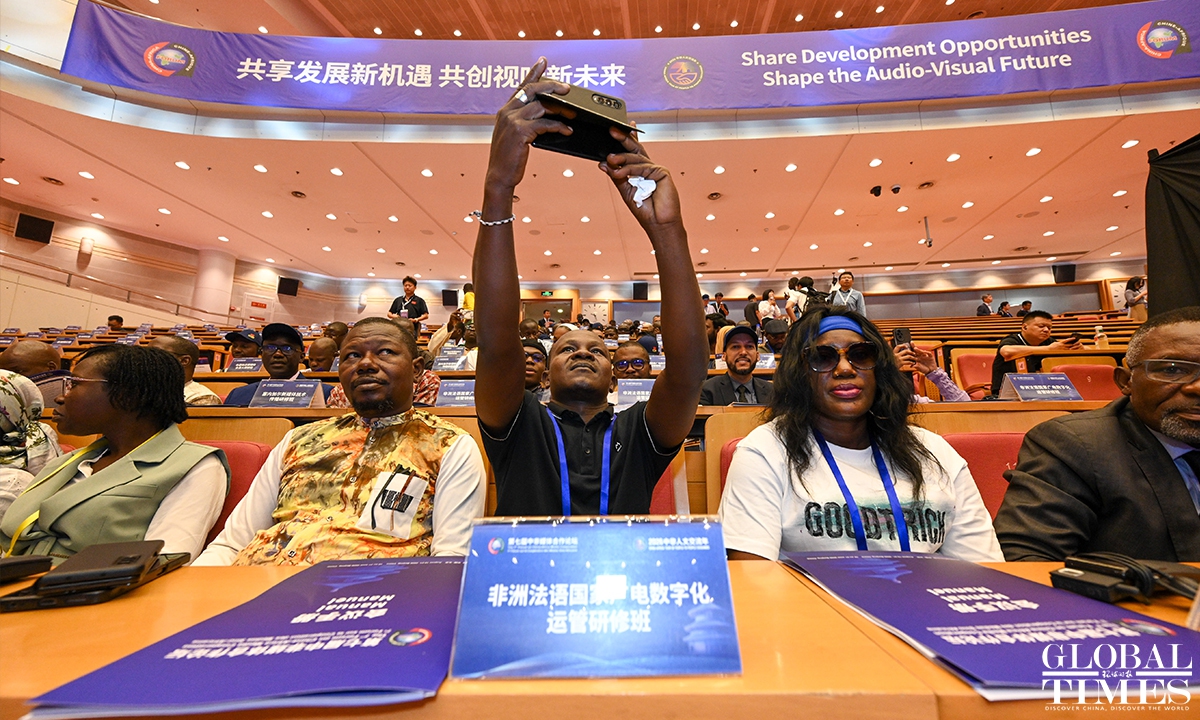
Clapping to the beat and humming the famous Chinese folk song "Jasmine Flower," one of the African delegates at the 7th China-Africa Media Cooperation Forum joined Unitree robots in an impromptu joint rendition of the classic Chinese melody, with the robots playing guitar and drums, in Beijing on Thursday.
The lively scene was observed as the 7th China-Africa Media Cooperation Forum officially opened in Beijing on Thursday, with the attendance of 33 minister-level delegates from African countries, marking a record-high level of participation. Participants also released the Joint Declaration of the 7th China-Africa Media Cooperation Forum.
Chinese and African guests held in-depth dialogues on a range of topics, including tech-empowered creative content, trade of audio-visual services, and the application of AI in radio, television and audio-visual sectors.
Gregoire Ndjaka, director general of the African Union of Broadcasting (AUB), said Chinese technology and equipment have made an important contribution to the development and modernization of broadcasting infrastructure in Africa.
He was very happy to confirm that, based on this cooperation, China donated equipment to the AUB Content Exchange Center located in the capital of Albania, and that the AUB has benefited greatly from it, Ndjaka said.
Ndjaka said there are significant opportunities to deepen cooperation, particularly in modern equipment, lightweight production and modern broadcasting systems. The AUB is preparing to establish a training center in Senegal's capital Dakar, which will host a pan-African broadcasting and television station, he noted.
The importance of access to Chinese technology was also highlighted by Mouhamadou El Bachir Diouf, a young participant from Senegal, who tried out Chinese-made VR glasses at the entrance to the forum.
Diouf told the Global Times that his country does not have such equipment and expressed hope that Chinese technologies and equipment could be introduced to Dakar as cooperation between the two sides develops.
Chernor Abduli Bah, Sierra Leone's Minister of Information and Civic Education, said China and Africa, within the framework of South-South cooperation, have a responsibility to ensure that their messages are communicated clearly.
"We are not here in competition with any entity," Bah said, stressing that China and Africa are seeking to foster a multilateral global order based on mutual respect, mutual benefit and the principle that every human being is equal.
He also called for global governance mechanisms to adapt to current realities, saying that the international order cannot simply continue to be defined by a framework established 70 years ago, as it no longer represents the realities and aspirations of many countries.
Whether involving the United Nations, international financial institutions or other global governance mechanisms, the international system should evolve to respond to changing realities, Bah said.
Evelyne Butoyi, Burundi's Minister of Communication and Media, said cooperation with China has brought tangible benefits to the country's broadcasting sector.
She cited a digital terrestrial television project through which Burundi and Chinese firm StarTimes jointly established Burundi Television Company. The project has improved television picture quality and enabled people in Burundi to access a wider range of better-produced programs, she said.
She also highlighted the "Access to Satellite TV for 10,000 African Villages" project carried out with StarTimes, saying that 500 villages in Burundi were included in the project. Set-top boxes were distributed free of charge to rural communities, allowing people in remote areas to watch digital television.
More than 80 Chinese TV series have appeared on African screens over the past two years, including "The Three-Body Problem" and "To the Wonder," according to an introduction at the opening ceremony.
China-Africa mutually beneficial cooperation, however, has drawn criticism from some Western media outlets. A recent New York Times report said that Chinese AI models are widely favored by African developers because they are cheap and freely available, potentially weakening US dominance in the global AI race.
Commenting on the report, Allawi Ssemanda, executive director of Uganda's Development Watch Center, told the Global Times, "The New York Times will always find a way to portray Africa as simply looking for something cheap."
He said African users choose Chinese AI models for reasons beyond cost, including their user-friendliness and the quality of information they provide.
"Personally, I know that if I use an AI model developed in the US, it may be good, but it may not give me the facts I am looking for because of global politics. If you use a Chinese-developed model, you can get what you want."
Ssemanda also rejected the notion that the affordability of Chinese AI should be viewed as a weakness. China, as part of the Global South, understands that making AI prohibitively expensive would limit access for developing countries, he said.
His comments point to a broader concern among African countries: for many developing nations, the question is not which country dominates the global AI race, but whether technological advances can be made accessible and translated into tangible development opportunities.
Thierry Lézin Moungalla, Minister of Communication and Media and government spokesperson of the Republic of the Congo, echoed this point, saying African countries continue to grapple with the digital divide.
"However, we can believe in the friendship, support and practical cooperation offered by China," Moungalla said.
。
Current article:http://yuv9tq.cuozubeishenjingli.cfd/injw1ys/20260826/95036.html
Published on:03:20:42
- 7964第五人格
- 37965外交部回应美方威胁对伊朗贸易伙伴实施二级制裁
- 4435447法治护航让杭州生态保护可感可及
- 87578"房门"快速通"舱门" 厦门翔安国际机场酒店群年底投用
- 4622871Kun哥独家爆料:PS+9月会免曝光!索尼这次拉了?
- 52785解读ChatGPT Atlas背后的数据边界之战
- 5870498【现货】8月26日各企业玻璃出厂价格汇总
- 289416China's digital industry revenue tops 20 trillion yuan in H1
- 3604366CDPR CEO 谈《巫师 4》:超 500 人倾力打造,迄今最大、最大胆、最具雄心作品
- 4750Canada, Sweden Send Military Instructors to Train Ukrainian Troops: Why is the West Fanning Flames?
- 9884【丁荷·乐】家园“童”行,共筑成长——2024学年第一学期家长助教活动
- 725476拉科布回应勇士125亿估值:无论如何我都不会卖
- 32372025年618淘宝京东什么时候开始购买最划算,618活动从6月16日20点开始最便宜优惠!
- 980573《天堂》开发商生存射击游戏《TIME TAKERS》9月全球测试
- 755掌握这6项隐藏功能,使您的支付宝账户更加安全。
- 593101中金:钽铌行业供需格局重塑 战略价值重估
- 4563全球首批“杭州产”抗癌新药获批上市
- 1333179男子地铁上神情恍惚 公然抽电子烟引嗑药疑云
- 2204145(乡村行·看振兴)太原小店区:一颗葡萄串起农文旅融合链,(乡村行·看振兴)太原小店区:一颗葡萄串起农文旅融合链
- 777汇款遭冻结风波近一年 部分苦主拿回全额血汗钱
- 742322中印边界问题特别代表在北京举行会晤
- 98564362025年淘宝京东618活动哪天买最便宜优惠力度最大?确认6月17日20点开始到18日全天
我的网站热门国内
- Copyright @ 2016-2017 我的网站 版权所有